Showing posts with label new image. Show all posts

Monday, 1 December 2014

If you let someone else tell your story, don’t be surprised if they getit wrong

The topic of misrepresentation in mainstream media is one that many people of African and Caribbean heritage are all too familiar with. To many, we are portrayed in a limited number of lights, none of which rightly represent us as a people. Products of broken families, having problems with education and perpetually on the other side of the law are only a few of the portrayals that many object to.


As much as there is a point here, I often wonder what else people expect when most of the creators of these representations are not from the Afro-Caribbean community.
Top Boy (TV show) and Pigeon English (novel) are two depictions of Afro-Caribbeans that have enjoyed good mainstream success in the recent past but it is worth noting that both are written by white authors. Top Boy, for example, has a predominantly black cast but is written by Ronan Bennett, an Irish writer. I am not for a second suggesting that white authors should not write about Afro-Caribbeans (I thoroughly enjoyed Top Boy) but I think we need some stories about us, written by us.

What's your story?


There is much to be said about the need for a revolution in the Afro-Caribbean community to unearth a new generation of opinion formers and thought leaders who will go into the world with our stories. To add a variety of stories to the mix that until now have not been given the attention they deserve.
As the playing field has already been set, we will need to raise people who will be ready to play by the existing rules and standards. People who have a clear understanding of their own culture and stories, as well as a balanced and accurate understanding of the mainstream cultures that we will be trying to appeal to.  There is also the option of creating an entirely new playing field to favour our stories but I am not a big fan of this. Skewered as the existing playing field might be, to intentionally sideline others would be just as wrong as what we are trying to correct.
Let’s not fool ourselves, there are problems in the Afro-Caribbean community with broken families, criminality and other things. To ignore these problems for the sake of painting a rosy picture will be just as detrimental as any other misrepresentation. We need to hear about the gang members as much as we need to hear about the budding artists. An accurate picture is not always the prettiest picture, it gains its beauty from showing the truth for what it is.

Thursday, 3 January 2013

Redefining Africa – refreshing the narrative, reconstructing the image


In June 2012, at the height of Spain's financial crisis and whilst negotiating terms of a bailout for Spanish banks, Spanish Prime Minister Mariano Rajoy sent a text message to his finance minister urging him to hold out for a good deal. The text read: “ we are the number four power in Europe. Spain is not Uganda”. The Spanish Prime Minister, like most people, assumed that a well known European country like Spain would be better off than a little known African country like Uganda. But contrary to that impression, it turned out that Uganda's economy was in a significantly better state that Spain's, with lower unemployment, higher GDP growth and no need for a bailout. I bet you didn't know that!

For a while now, many commentators have lamented the lack of balance in Western media when it comes to stories out Africa. They argue that you are more likely to see adverts asking you to donate £2 a month to support starving African children, stories about civil wars and corruption or a documentary about wildlife and the 'beauty of Africa' than to hear about innovation, Africa's contribution to science, technology and other aspects of life that other continents get credit for.

There is rarely a mention of the rate at which many African economies are growing and how many European businesses are annexing to Africa in a bid to turn a profit as Europe continues to face economic difficulties. Barely any column inches dedicated to the growth of countries like Ghana and Nigeria, who are making huge strides in business, leading to a repatriation of many indegenes who had previously made their home in various other parts of the world

Corruption is undoubtedly still a problem but compared to how bad things used to be, huge strides have been made in the right direction and things are a lot better. But when you ask many, they can hardly complete a sentence about anything concerning Africa without making a reference to corruption and civil war etc, as if no such thing ever happened or is still going on in other parts of the world.

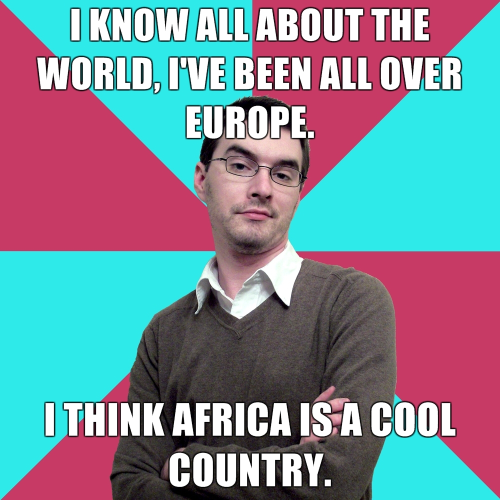
Africa is not a country. Redefining Africa


Also, when it comes to telling the story of early interactions between Africans and the rest of the world, the impression is generally that Africans were naked, primitive novices who were far removed from what was happening in the outside world. No mention of the likes of the people of Oyo and Edo Empires in Nigeria, who had Portuguese-speaking mathematicians among their people when the British first made contact with them and had been doing business with Europe as far back as the 15th Century. Rarely a mention of the Library of Alexandria in Egypt, which once stood as one of the most significant in the world before it was destroyed

The list of stories about the history of the African continent as a whole, where it is now and prospects for the future is as boundless as you'll find about any other continent. Not to talk of stories of individuals, peoples and countries.

To reduce Africa to a single story of corruption, diseases, poor people, war and pretty wildlife would be just as ignorant as reducing South America to drugs, kidnappings and problems with gang culture, and to reduce Europe to Nazism, Kosovo, a past filled with pillaging and crippled economies that show no sign of getting back to their feet any time soon.

But perhaps like Europe and some other parts of the world have done, Africa needs to take control of its own image and begin to tell its own story a bit more. To embark on a charm offensive with the aim of changing minds and influencing opinions, and to put specific effort towards redressing the issue of balance. The longer we let others tell our story, the more they will leave out. Not out of malice or ill will but because it is not really their story to tell.

There is more to Africa than wildlife, diseases, poor people and corruption but unless Africans begin to tell the world the other stories, the rest of the world will ever know.


Featured post

Five man-made wonders that will change your opinion of African architecture

For most people, when you talk about African architecture, especially before European colonisation, you have the pyramids in Egypt and mud ...