Showing posts with label Redefining Africa. Show all posts

Monday, 1 December 2014

If you let someone else tell your story, don’t be surprised if they getit wrong

The topic of misrepresentation in mainstream media is one that many people of African and Caribbean heritage are all too familiar with. To many, we are portrayed in a limited number of lights, none of which rightly represent us as a people. Products of broken families, having problems with education and perpetually on the other side of the law are only a few of the portrayals that many object to.


As much as there is a point here, I often wonder what else people expect when most of the creators of these representations are not from the Afro-Caribbean community.
Top Boy (TV show) and Pigeon English (novel) are two depictions of Afro-Caribbeans that have enjoyed good mainstream success in the recent past but it is worth noting that both are written by white authors. Top Boy, for example, has a predominantly black cast but is written by Ronan Bennett, an Irish writer. I am not for a second suggesting that white authors should not write about Afro-Caribbeans (I thoroughly enjoyed Top Boy) but I think we need some stories about us, written by us.

What's your story?


There is much to be said about the need for a revolution in the Afro-Caribbean community to unearth a new generation of opinion formers and thought leaders who will go into the world with our stories. To add a variety of stories to the mix that until now have not been given the attention they deserve.
As the playing field has already been set, we will need to raise people who will be ready to play by the existing rules and standards. People who have a clear understanding of their own culture and stories, as well as a balanced and accurate understanding of the mainstream cultures that we will be trying to appeal to.  There is also the option of creating an entirely new playing field to favour our stories but I am not a big fan of this. Skewered as the existing playing field might be, to intentionally sideline others would be just as wrong as what we are trying to correct.
Let’s not fool ourselves, there are problems in the Afro-Caribbean community with broken families, criminality and other things. To ignore these problems for the sake of painting a rosy picture will be just as detrimental as any other misrepresentation. We need to hear about the gang members as much as we need to hear about the budding artists. An accurate picture is not always the prettiest picture, it gains its beauty from showing the truth for what it is.

Thursday, 26 June 2014

Five man-made wonders that will change your opinion of African architecture

For most people, when you talk about African architecture, especially before European colonisation, you have the pyramids in Egypt and mud huts everywhere else. It sometimes feels like the only thing rarer than the telling of the African architectural story is the accurate telling of that story.

I was on the Southbank in London very recently where I was offended to see a display by a well-known global charity encouraging passers-by to 'Step into Africa', with arrows pointing to some ramshackle huts. There were also some “African drums” on display. Like Africa's only contribution to the world were mud huts and drums.

I couldn't bring myself do more than glance into the huts as I walked past and I have no doubt that the charity had all the right intentions to help but this representation of African architecture and the African story in general needs to stop. It is time for a more balanced telling of the African story and this is my contribution to that process.

I have put together a list of five man made structures from different parts of Africa that I don't think many people would have heard of. All of these edifices where constructed before European colonisation and are, in my opinion, are some of the world's greatest wonders.


Benin Moat (or The Walls of Benin)


Referred to by many as Africa's 'Great Wall of China', the Benin Moat was used as a defense by the historical Benin Empire from neighbouring empires like Oyo and Sokoto. It was considered the largest man-made structure lengthwise and was hailed as the largest earthwork in the world.

Walls of Benin


According to Fred Pearce of the New Scientist, “they extend for some 16,000 kilometres in all, in a mosaic of more than 500 interconnected settlement boundaries. They cover 6,500 square kilometres and were all dug by the Edo people. In all, they are four times longer than the Great Wall of China, and consumed a hundred times more material than the Great Pyramid of Cheops. They took an estimated 150 million hours of digging to construct, and are perhaps the largest single archaeological phenomenon on the planet.

Excavations by British archaeologist Graham Connah in 1960 uncovered a rural network of earthen walls that, he estimated, if spread out over five dry seasons, would have required a workforce of 1,000 labourers working ten hours a day, for seven days a week to construct – a rough total of 150 million man hours.

Walls of Benin


The invasion and subsequent annexation of the Benin Empire by the British led to the destruction of long stretches of the wall. As a result of this and poor maintenance by locals, the Benin Moat today lies fallow and largely forgotten, a pale reflection of its former self.

Rock-Hewn Churches, Lalibela


Rock-Hewn Churches


In a mountainous region in the heart of Ethiopia, some 645 km from Addis Ababa, eleven medieval monolithic churches were carved out of rock. Their building is attributed to King Lalibela who set out to construct in the 12th century a ‘New Jerusalem’, after Muslim conquests halted Christian pilgrimages to the holy Land.

The churches were not constructed in a traditional way but rather were hewn from the living rock of monolithic blocks. These blocks were further chiselled out, forming doors, windows, columns, various floors, roofs etc. This gigantic work was further completed with an extensive system of drainage ditches, trenches and ceremonial passages, some with openings to hermit caves and catacombs.

The churches are also a significant engineering feat, given that they are all associated with water (which fills the wells next to many of the churches) exploiting an artesian geological system that brings the water up to the top of the mountain ridge on which the city rests.

Great Mosque of Djenne


Great Mosque of Djenne


The actual date of the of construction of the mosque is unknown but the Great Mosque of Djenne is acclaimed by many as one of Africa's greatest architectural accomplishments. The first mosque on the site was built in the 13th century, but the current structure dates from 1907.

The earliest document mentioning the mosque is al-Sadi's Tarikh al-Sudan which gives the early history, presumably from the oral tradition as it existed in the mid seventeenth century. The tarikh states that a Sultan Kunburu became a Muslim and had his palace pulled down and the site turned into a mosque. He built another palace for himself near the mosque on the east side.His immediate successor built the towers of the mosque while the following Sultan built the surrounding wall.

The walls of the Great Mosque are made of sun-baked earth bricks (called ferey), and sand and earth based mortar, and are coated with a plaster which gives the building its smooth, sculpted look. The walls of the building are decorated with bundles of rodier palm sticks, called toron, that project about 60 cm (2 ft) from the surface. The toron also serve as ready made scaffolding for the annual repairs. Ceramic half-pipes also extend from the roofline and direct rain water from the roof away from the walls


Great Zimbabwe


Great Zimbabwe


Some have claimed that Great Zimbabwe is the largest medieval city in sub-Saharan Africa. Great Zimbabwe was constructed and expanded for more than 300 years in a local style that eschewed rectilinearity for flowing curves. Neither the first nor the last of some 300 similar complexes located on the Zimbabwean plateau, Great Zimbabwe is set apart by the terrific scale of its structure. Its most formidable edifice, commonly referred to as the Great Enclosure, has dressed stone walls as high as 36 feet (11 m) extending approximately 820 feet (250 m), making it the largest ancient structure south of the Sahara Desert. Houses within the enclosure were circular and constructed of wattle and daub, with conical thatched roofs.

Gidan Rumfa


Palace of the Emir of Kano


The Gidan Rumfa is the palace of the Emir of Kano, located in Kano, Kano State, Nigeria, and was built by Mohammed Rumfa, who reigned from 1463 to 1499. The entire palace is embraced by a wall 20 to 30 feet high from the outside, the height of which never exceeds more than 15 feet from the inside.

Visitors at the turn of the twentieth century commented on the wall's durability, which was said to have been 15 feet thick in some places. It is tapered inward and surmounted by rounded crenellations. The exterior wall, similar to the exteriors of the buildings inside the complex, is modestly decorated with shallow arched grooves traced in the mud plaster. The eleven mile wall was once surrounded by a moat with a parapeted bridge to the main south gate.


There are many more marvellous works of African architecture all over the continent and it is a shame that out of all of these, the humble mud hut seems to be synonymous with the idea of ancient African architecture. Mud huts are an undeniable part of African architectural heritage but until we begin to acknowledge and appreciate the other side of the story, we will be telling a incorrect version of another part of Africa's story  

Monday, 11 November 2013

Just because it's Western doesn't mean it's better

Growing up in Nigeria in the 90s, very little was done to encourage any sense of ‘Nigerianness’ or patriotism. Buying locally made products was seen as a sign of poverty and bad taste, and some even thought speaking any of the indigenous languages was a sign of illiteracy.

We were actively encouraged to be more Western and pride was found in mundane things like speaking with an American accent. Many of my contemporaries went on to struggle with their sense of identity as it proved almost impossible to marry Western ideals with West African realities.

Just because it's Western doesn't mean it's better
 

Fast forward to the present day and a lot has been done to foster patriotism. Boasting Africa’s largest movie industry and one of the most vibrant music industries in the world, young Nigerians now proudly support these locally made products without any fear of denigration. But the battle is not yet won. There is still a lingering sense of Western superiority by default, not only in Nigeria but across Africa.

For many years, the image of Africa beamed across the world was that of poverty, war and corruption, sprinkled with something about great wildlife. The old rhetoric of helpless Africans needing the help of well-meaning Westerners has become the accepted narrative. So much that many Africans have even come to accept it as the undisputable truth. Many, as a default reaction, now automatically turn to the West and Western ways for solutions to all problems, without any consideration for context or the reality that an ideology is not perfect simply because it is Western.

For example, trade liberalisation, an initiative pioneered by The World Bank and IMF to boost trade between the developing world and the rest of the world, reportedly cost sub-Saharan Africa $272 billion between 1985 and 2005. Imports went up but there wasn't much change in terms of exports. Had this not been the case, the countries affected would have had enough extra income to wipe out their debts and still have more than enough left over. In the process of implementing trade liberalisation, African women, traditionally involved in small scale entrepreneurship, were also systematically side-lined, severely affecting their role and contribution to rural communities. But despite this, and the absence of any signs of improvement, many African commentators still insist that trade liberalisation is the right way to go.

I believe it is time for Africans to lose the inferiority complex and bang the drum about their culture regardless of whether or not it conflicts with Western ideologies. Japan and China provide a great template for how to do this whilst ensuring progression and modernization.

Japan, for example, seems to have been able to achieve both modernization and the preservation of its distinctive culture. They have adopted a brand of cultural adaptability that has allowed them to learn from other cultures and adapt them to their own purposes. There have been some changes, as with any other culture, but not at the expense of the values their society was founded on. The absorption of Western science, technology and learning has been done over the years with open eyes and honest evaluation, not blind acceptance.

In the name of enlightenment, many cultures in Africa face the threat of extermination under the heavy strain of Western powers who are taking advantage of ongoing struggles. It can even be said that many parts of Africa are in the middle of a second wave of colonization that is both subtle and ruthless at the same time.

There is so much more to be said on this topic but the fact of the matter is that no culture or ideology is perfect. Every culture has its plus points and negatives and it would be grossly unfair to only speak of the positives of one while only speaking of the other’s negatives.

The saying goes that ‘Everybody is a genius. But if you judge a fish by its ability to climb a tree, it will live its whole life believing it is stupid’. To judge Africa according to Europe is unfair at best and at worst, malicious. If we judge Africa on what it does well and not on what Europe does better, maybe we will then be able to see what it has to offer its people and in turn the rest of the world.


Thursday, 3 January 2013

Redefining Africa – refreshing the narrative, reconstructing the image


In June 2012, at the height of Spain's financial crisis and whilst negotiating terms of a bailout for Spanish banks, Spanish Prime Minister Mariano Rajoy sent a text message to his finance minister urging him to hold out for a good deal. The text read: “ we are the number four power in Europe. Spain is not Uganda”. The Spanish Prime Minister, like most people, assumed that a well known European country like Spain would be better off than a little known African country like Uganda. But contrary to that impression, it turned out that Uganda's economy was in a significantly better state that Spain's, with lower unemployment, higher GDP growth and no need for a bailout. I bet you didn't know that!

For a while now, many commentators have lamented the lack of balance in Western media when it comes to stories out Africa. They argue that you are more likely to see adverts asking you to donate £2 a month to support starving African children, stories about civil wars and corruption or a documentary about wildlife and the 'beauty of Africa' than to hear about innovation, Africa's contribution to science, technology and other aspects of life that other continents get credit for.

There is rarely a mention of the rate at which many African economies are growing and how many European businesses are annexing to Africa in a bid to turn a profit as Europe continues to face economic difficulties. Barely any column inches dedicated to the growth of countries like Ghana and Nigeria, who are making huge strides in business, leading to a repatriation of many indegenes who had previously made their home in various other parts of the world

Corruption is undoubtedly still a problem but compared to how bad things used to be, huge strides have been made in the right direction and things are a lot better. But when you ask many, they can hardly complete a sentence about anything concerning Africa without making a reference to corruption and civil war etc, as if no such thing ever happened or is still going on in other parts of the world.

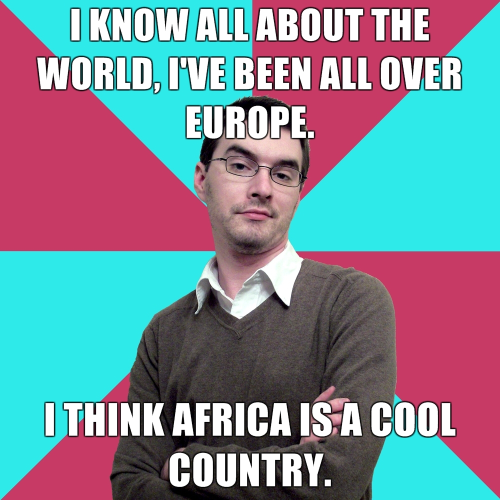
Africa is not a country. Redefining Africa


Also, when it comes to telling the story of early interactions between Africans and the rest of the world, the impression is generally that Africans were naked, primitive novices who were far removed from what was happening in the outside world. No mention of the likes of the people of Oyo and Edo Empires in Nigeria, who had Portuguese-speaking mathematicians among their people when the British first made contact with them and had been doing business with Europe as far back as the 15th Century. Rarely a mention of the Library of Alexandria in Egypt, which once stood as one of the most significant in the world before it was destroyed

The list of stories about the history of the African continent as a whole, where it is now and prospects for the future is as boundless as you'll find about any other continent. Not to talk of stories of individuals, peoples and countries.

To reduce Africa to a single story of corruption, diseases, poor people, war and pretty wildlife would be just as ignorant as reducing South America to drugs, kidnappings and problems with gang culture, and to reduce Europe to Nazism, Kosovo, a past filled with pillaging and crippled economies that show no sign of getting back to their feet any time soon.

But perhaps like Europe and some other parts of the world have done, Africa needs to take control of its own image and begin to tell its own story a bit more. To embark on a charm offensive with the aim of changing minds and influencing opinions, and to put specific effort towards redressing the issue of balance. The longer we let others tell our story, the more they will leave out. Not out of malice or ill will but because it is not really their story to tell.

There is more to Africa than wildlife, diseases, poor people and corruption but unless Africans begin to tell the world the other stories, the rest of the world will ever know.


Featured post

Five man-made wonders that will change your opinion of African architecture

For most people, when you talk about African architecture, especially before European colonisation, you have the pyramids in Egypt and mud ...